The Digambar Tradition
Sky clad. What the word means, how the two traditions came apart, and what it looks like in this mandir.
History and tradition
3 min read
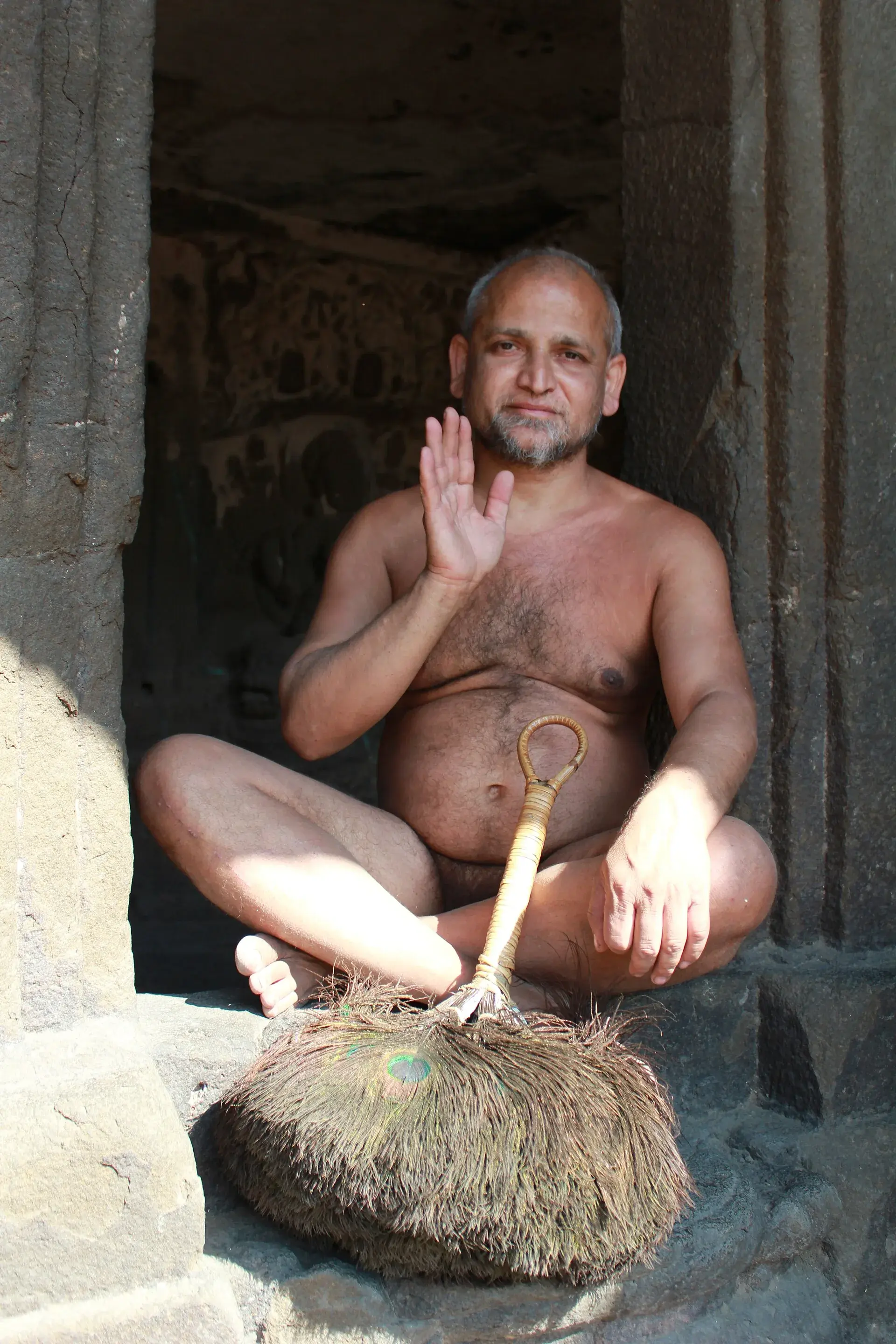
Arian Zwegers from Brussels, Belgium, Ellora, cave 33, Digambar Jain guru, CC BY 2.0. Resized and converted to WebP.
What the word means
Digambar joins dig, meaning direction or sky, to ambar, meaning garment. Sky clad. Male ascetics of this tradition own nothing whatever, and clothing is counted among the things owned.
The reasoning follows from aparigraha taken to its conclusion. If non-possession is a vow rather than a preference, then a limit set anywhere is still a limit chosen for comfort, and the only position without an arbitrary line is to keep nothing. A Digambar muni carries a picchi, a soft whisk of peacock feathers moulted naturally, to clear a place before sitting so that no creature is crushed, and a kamandalu of water for cleanliness. That is the whole of it.
Female ascetics in this tradition are called aryikas and keep a single unstitched white sari.
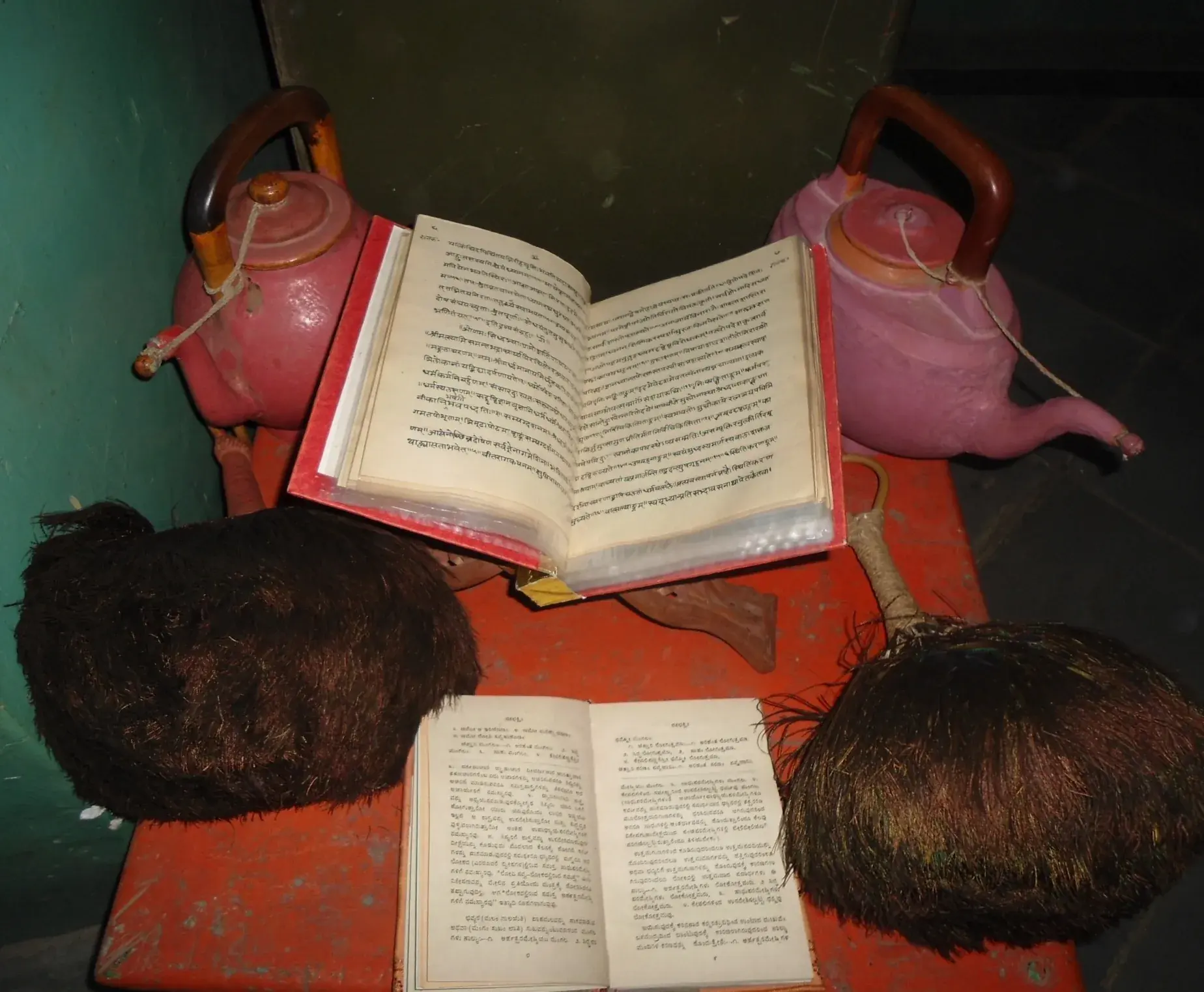
M, Pichi kamandal shastra, CC BY-SA 4.0. Converted to WebP.
How the two traditions came apart
Both traditions tell the story from their own side, and it is fairer to give both than to pick one.
The Digambar account places the parting around the 4th century BCE. Acharya Bhadrabahu foresaw a twelve year famine in Magadha and led a body of ascetics south. Those who stayed found the original discipline impossible to keep through the famine and began wearing white, and the Digambars hold that they themselves preserved the practice as Mahavir kept it.
The Svetambar account places it much later, in the first or second century of the common era, and attributes it to a monk named Sivabhuti who adopted nudity out of pique.
Modern scholarship reads it as neither. There appears to have been no single event at all, but a gradual hardening over several centuries of what had earlier been two acceptable options within one community. Sculpture from Mathura in the Kushan period shows unclothed Tirthankar images from the first century of the common era, which suggests both practices coexisted for a long time before either became a boundary.
What it looks like in this mandir
The doctrine of restraint shows up as an aesthetic, and a visitor who has seen a Svetambar derasar will notice the difference at once.
- The murti is unadorned. No jewellery, no crown, no applied eyes, no silver foil. The eyes are half closed, turned inward rather than outward at the viewer.
- Abhishek is performed with water, and offerings are of dry substances: rice, sandal, flowers, incense, lamp, whole grain, fruit. Nothing is offered that had to be killed to obtain.
- The ashtamangala arranged before the image are the Digambar eight, not the set usually illustrated online.
Terms on this page
- Digambarदिगंबर
- Sky clad, from dig, direction or sky, and ambar, garment. Male ascetics of this tradition keep no possessions at all, clothing included.
- Aryikaआर्यिका
- A female ascetic in the Digambar tradition, who keeps a single unstitched white sari.
- Moolnayakमूलनायक
- The principal image of a mandir, the one the building is oriented around. Here it is Bhagwan Vimalnath.
Common questions
Are Digambar and Svetambar different religions?
No. They are two traditions within one dharma. They share the twenty-four Tirthankars, the five vows, the three jewels, the doctrine of karma, the Navkar Mantra and the Tattvarth Sutra. They differ on ascetic practice, on some points of doctrine, and on which texts survived.