The Twenty-four Tirthankars
From Rishabhdev to Mahavir, and Vimalnath the thirteenth, who is the Moolnayak of this mandir.
History and tradition
3 min read
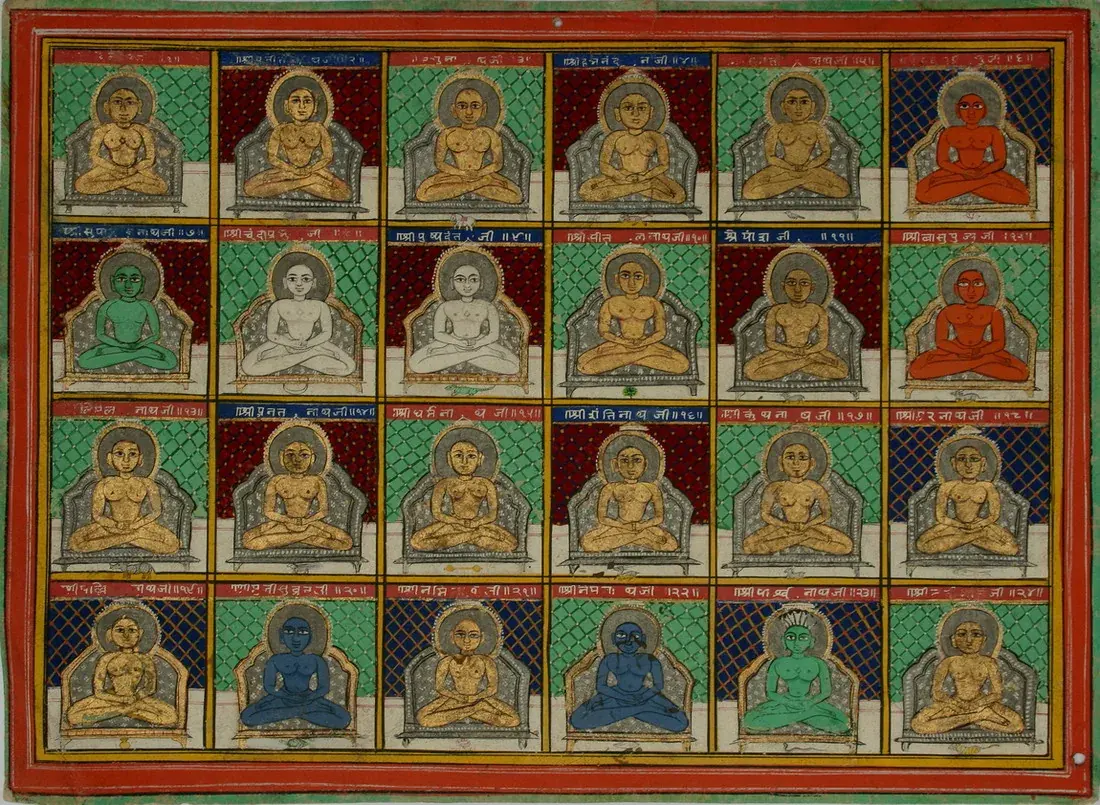
Unknown author, Jain miniature painting of the 24 Tirthankaras, Jaipur, c. 1850, Public domain. Converted to WebP.
What a Tirthankar is
The word means ford maker. A tirth is a crossing place on a river, and the image is of an ocean of birth and death that has to be crossed. A Tirthankar is a soul that has crossed and then marked the ford, so that others can follow where the water can be forded.
The marking is the fourfold order: monks, nuns, laymen and laywomen. That is what separates a Tirthankar from any other omniscient being. Many souls attain omniscience and are called kevalis; twenty-four in each half cycle also build the community that carries the teaching forward, and they are the Tirthankars.
After omniscience the samavasaran forms, a circular assembly in tiers where humans, animals and celestial beings gather, and where each is said to hear the teaching in its own language. It is the reason Jain art shows the Tirthankar surrounded by concentric rings rather than seated alone.
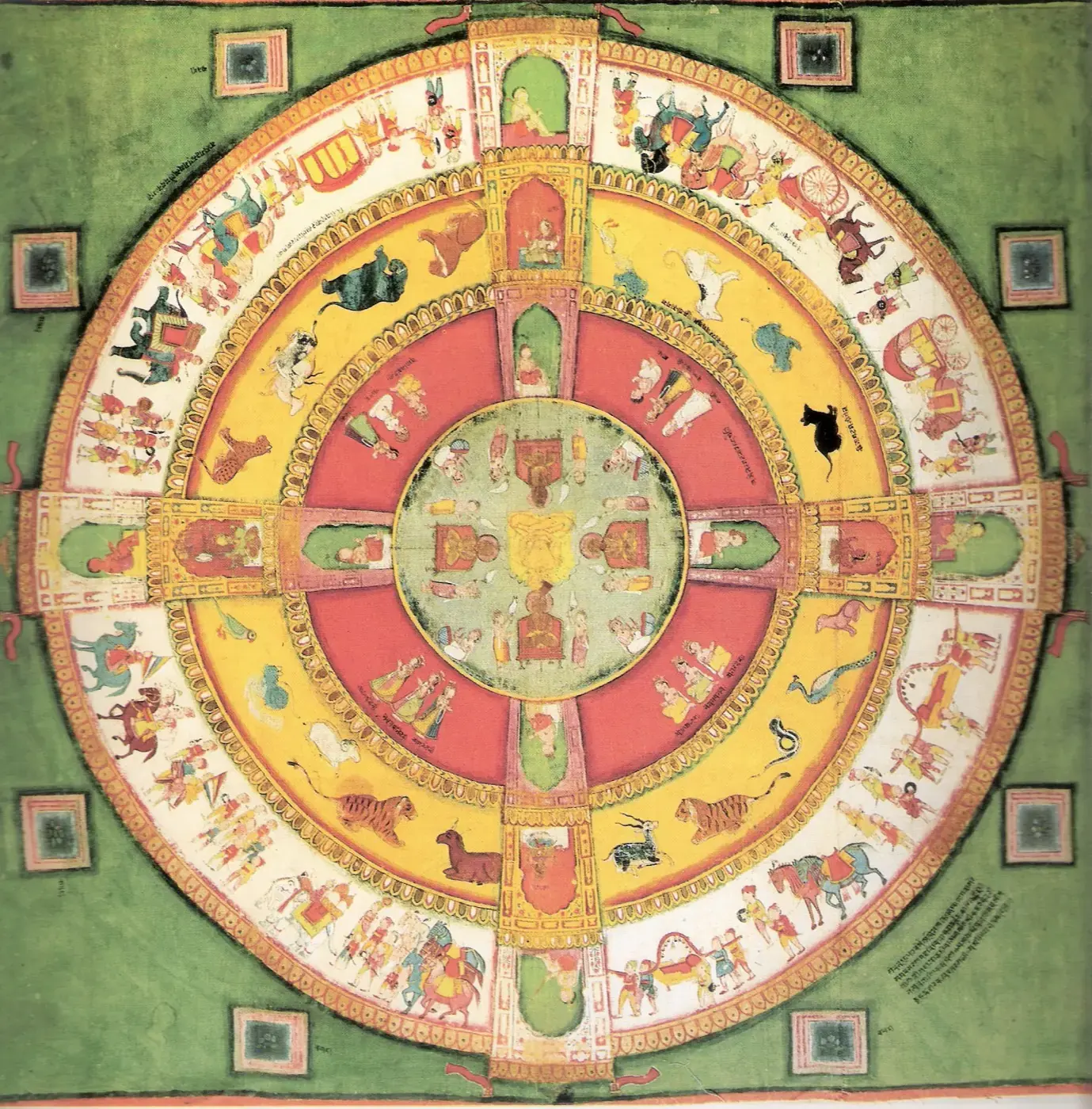
Unknown author, Samavasarana painting, Rajasthan, c. 1800, Public domain. Resized and converted to WebP.
The line of twenty-four
Rishabhdev, also called Adinath, is the first of the present half cycle. Jain tradition credits him with teaching agriculture, writing, and the arts of settled life before he renounced, which places him at the beginning of civilisation rather than merely of a religion.
Between him and Mahavir stand twenty-two others, among them Neminath the twenty-second, a cousin of Krishna in Jain accounts, and Parshvanath the twenty-third, recognisable everywhere by the hood of serpents above his head. Vimalnath is the thirteenth.
How to tell one image from another
Jain images of the Tirthankars are deliberately alike. There is no attempt at portraiture, no distinguishing expression, no ornament in the Digambar tradition. This is doctrinal rather than artistic: what is being shown is a soul in its own nature, and one liberated soul does not differ from another.
So identification is done by the lanchhan, an emblem carved on the pedestal beneath the figure. A bull is Rishabhdev, a lion is Mahavir, a serpent hood is Parshvanath, a boar is Vimalnath. When you visit any Jain mandir and want to know whose image you are before, look at the base rather than the face.
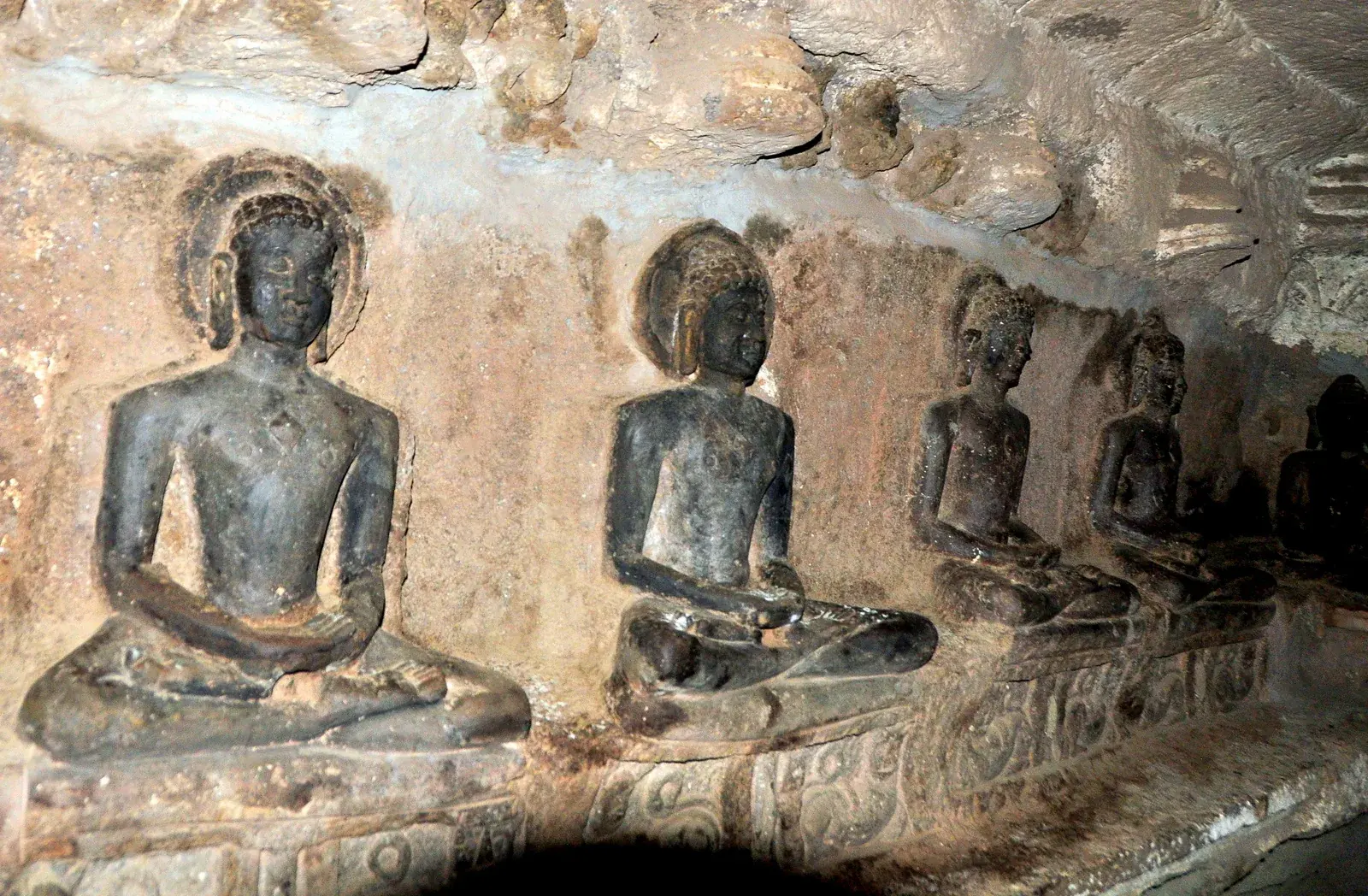
Anandbora72, Jain Tirthankar, Mangi-Tungi caves, CC BY-SA 4.0. Converted to WebP.
Vimalnath Bhagwan, the thirteenth
The Moolnayak of this mandir is Bhagwan Vimalnath. The name comes from vimal, meaning stainless or pure.
- Lanchhan
- The boar, varaha.
- Colour
- Golden.
- Birthplace
- Kampilya, in present day Uttar Pradesh.
- Parents
- King Kritavarma and Queen Shyama.
- Birth kalyanak
- The third of the bright fortnight of Magh.
- Moksha
- Attained at Shikharji, Sammed Shikhar, in present day Jharkhand, where his footprints are venerated.
- Attendant deities
- In the Digambar tradition, the yaksha Shanmukha and the yakshi Anantamati.
Terms on this page
- Tirthankarतीर्थंकर
- Ford maker. One who has crossed the ocean of rebirth and marks a crossing place for others by establishing the fourfold order.
- Lanchhanलांछन
- The emblem carved beneath a Tirthankar's image, and the only reliable way to tell one from another, since the figures themselves are deliberately identical.
- Samavasaranसमवसरण
- The circular preaching assembly that forms after a Tirthankar attains omniscience, in which every being present hears the teaching in its own language.
- Vimalnathविमलनाथ
- The thirteenth Tirthankar, whose emblem is the boar and whose colour is gold. The Moolnayak, the principal image, of this mandir.
Common questions
Are Tirthankars gods?
No. They were human beings who reached liberation by their own effort, and Jain dharma has no creator god at all. A liberated soul has no further connection with the world and cannot intervene in it. Worship before an image is a way of holding the ideal in view, not a request made to a being who might answer.
Why do all the images look the same?
Because what is depicted is the soul in its liberated state, and in that state one soul does not differ from another. Personality, expression and ornament would all be additions to something that is defined by having nothing added. The lanchhan on the pedestal is what identifies each one.