The Ashtamangala
The eight auspicious objects, the Jain swastika, and the emblem adopted in 1975.
Practice
4 min read
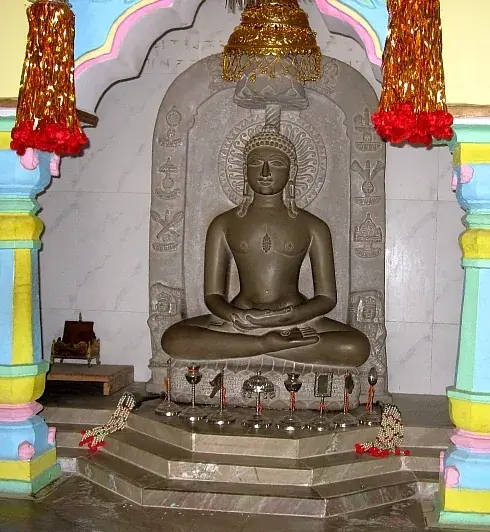
Malaiya, Bilahari Adinath image with Ashtamangala, CC BY-SA 3.0. Converted to WebP.
The eight objects
The ashtamangala are eight auspicious objects placed before the Jina during worship. They are not offerings to a deity, since a liberated soul receives nothing. They are articles of honour, arranged the way a great teacher would be received.
- Chhatra, the parasol, held over one worthy of honour.
- Dhvaja, the banner.
- Kalash, the full pot, the sign of abundance and of an auspicious beginning.
- Chamar, the fly whisk, waved in attendance.
- Darpan, the mirror, in which one sees oneself as one is.
- Bhadrasan, the seat.
- Vyajan, the hand fan.
- Supratishtha, the vessel.
The swastika, and what it actually diagrams
The swastika is among the oldest symbols in India and in Jain use it is a precise diagram rather than a decoration. Drawn in rice grains before the Jina during worship, it is read from the bottom upward.
- The four arms
- The four gatis, the four states a soul can be reborn into: heavenly being, human, animal or plant, and hellish being. The soul turns among them without pause, which is what the shape is meant to convey.
- The three dots above
- The ratnatraya: right faith, right knowledge and right conduct. The way out of the four arms lies through these three and through nothing else.
- The crescent and dot at the top
- The siddhashila, the abode of liberated souls at the summit of the universe, and a soul that has reached it. This is the top of the diagram because there is nothing above it.
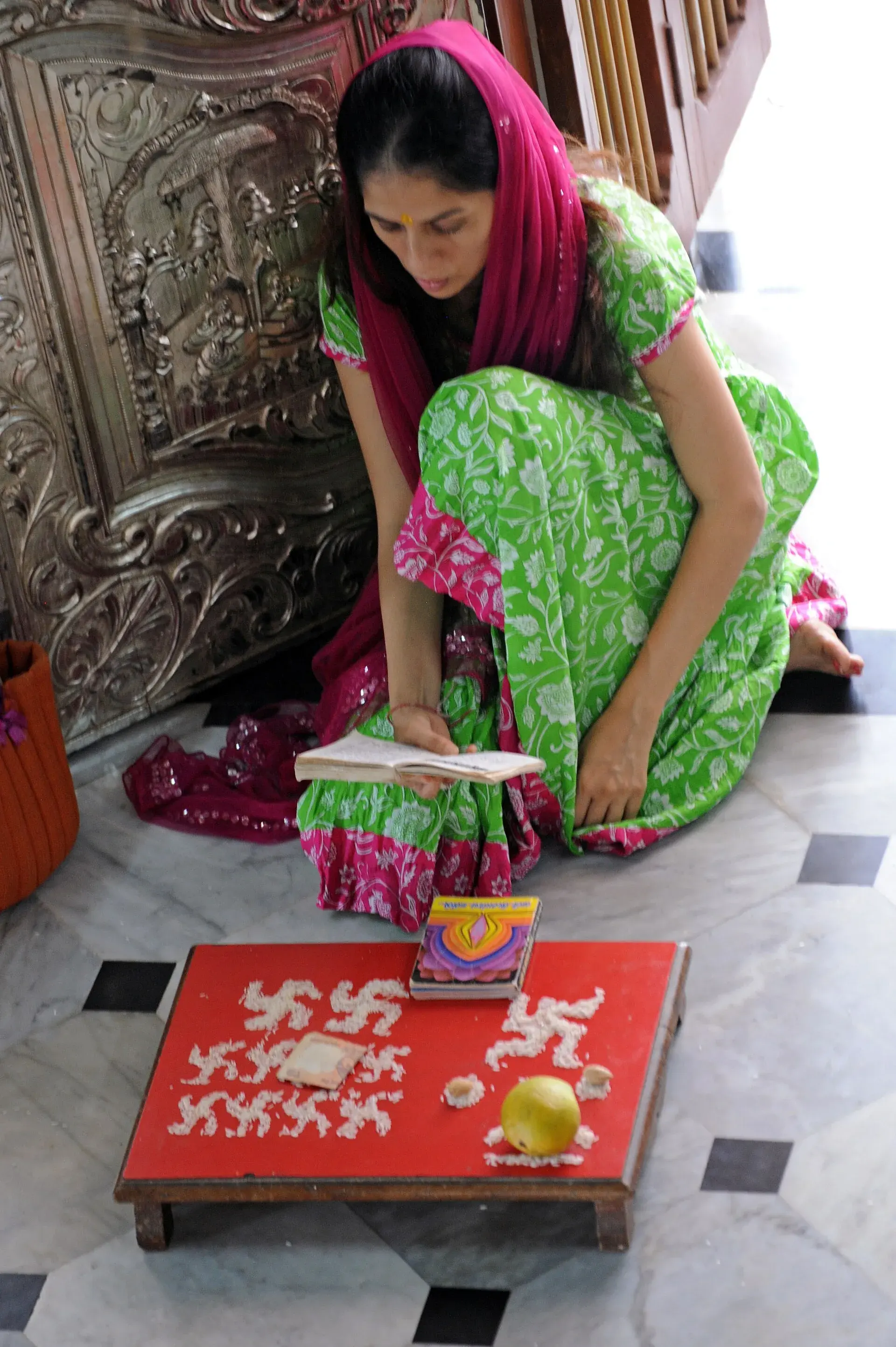
cerulean5000 from NYC, USA, A Jain ritual offerings and puja recital at a temple, CC BY 2.0. Resized and converted to WebP.
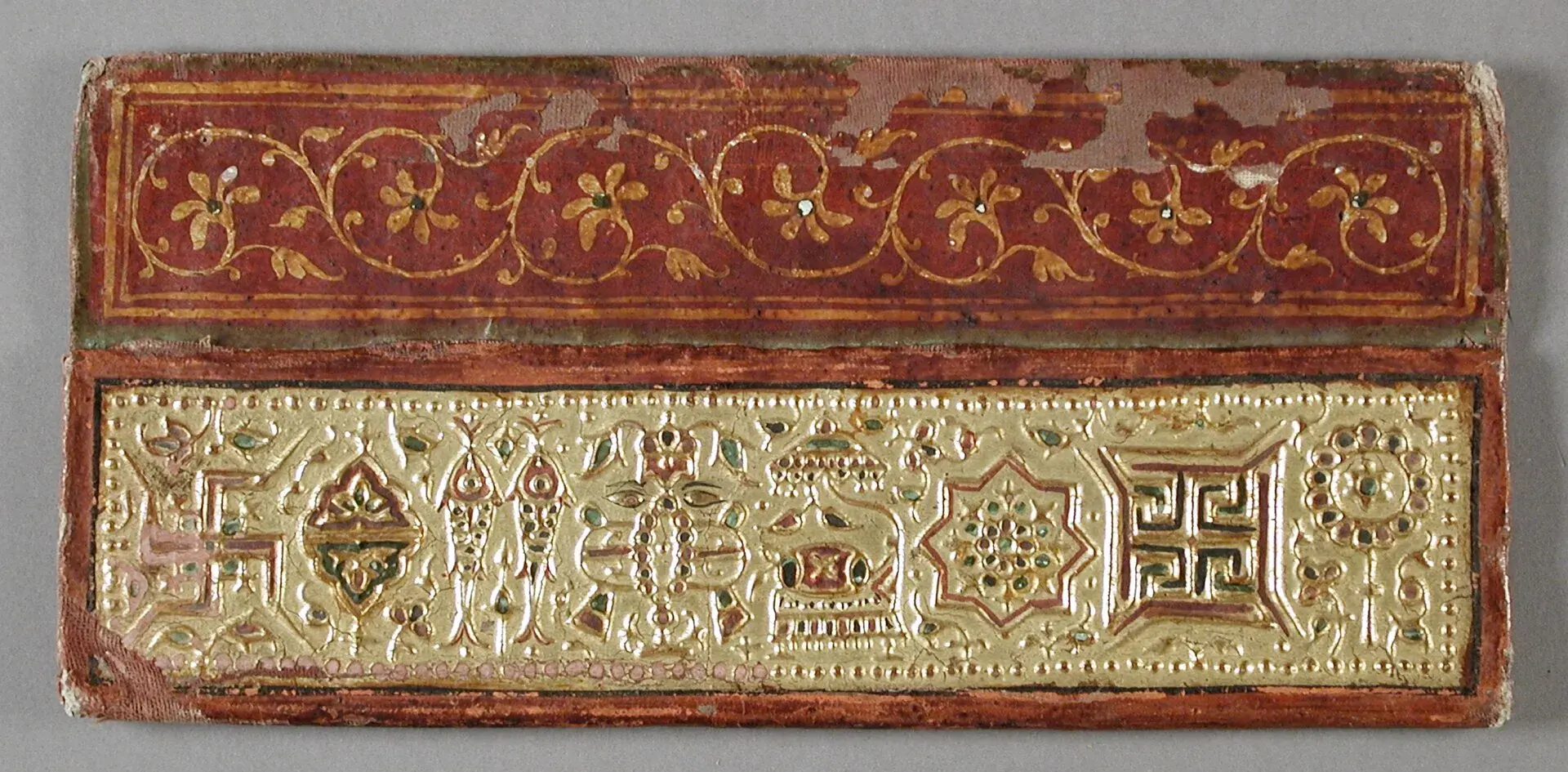
A Jain Manuscript Cover, western India, 16th century, LACMA M.72.53.22, Public domain. Resized and converted to WebP.
The 1975 emblem
In 1975, on the 2500th anniversary of Bhagwan Mahavir's nirvan, all Jain traditions agreed on a common emblem. Its outline is the loka, the occupied universe as the Jain scriptures describe it, shaped roughly like a standing figure with hands at the waist.
- The upper portion is the heavens, the middle the world of humans and animals, the lower the hells.
- The arc at the very top is the siddhashila, above all three realms, with the three dots of the ratnatraya beneath it.
- A swastika sits in the upper portion, and in the lower an open palm with a wheel of twenty-four spokes at its centre, one for each Tirthankar.
- Beneath it all runs the line parasparopagraho jivanam, all life is bound together by mutual support.
The open palm is the ahimsa hand. The gesture is the one meaning stop, and the wheel within it is the dharmachakra: the resolve to halt the turning of samsara by the pursuit of non-violence. The word ahimsa is usually written across the palm.
Terms on this page
- Ashtamangalaअष्टमंगल
- Eight auspicious objects placed before a Jina image during worship. The Digambar and Svetambar lists differ.
- Jain swastikaस्वस्तिक
- A diagram of rebirth: four arms for the four states of existence, three dots above for the three jewels, and a crescent for the abode of liberated souls.
- Jain Prateek Chihnaजैन प्रतीक चिह्न
- The emblem adopted in 1975 on the 2500th anniversary of Mahavir's nirvan, showing the shape of the occupied universe.