The Nine Tattvas
Nine fundamentals that describe the soul, the karma that binds it, and the exact process by which it gets free.
Principles
3 min read
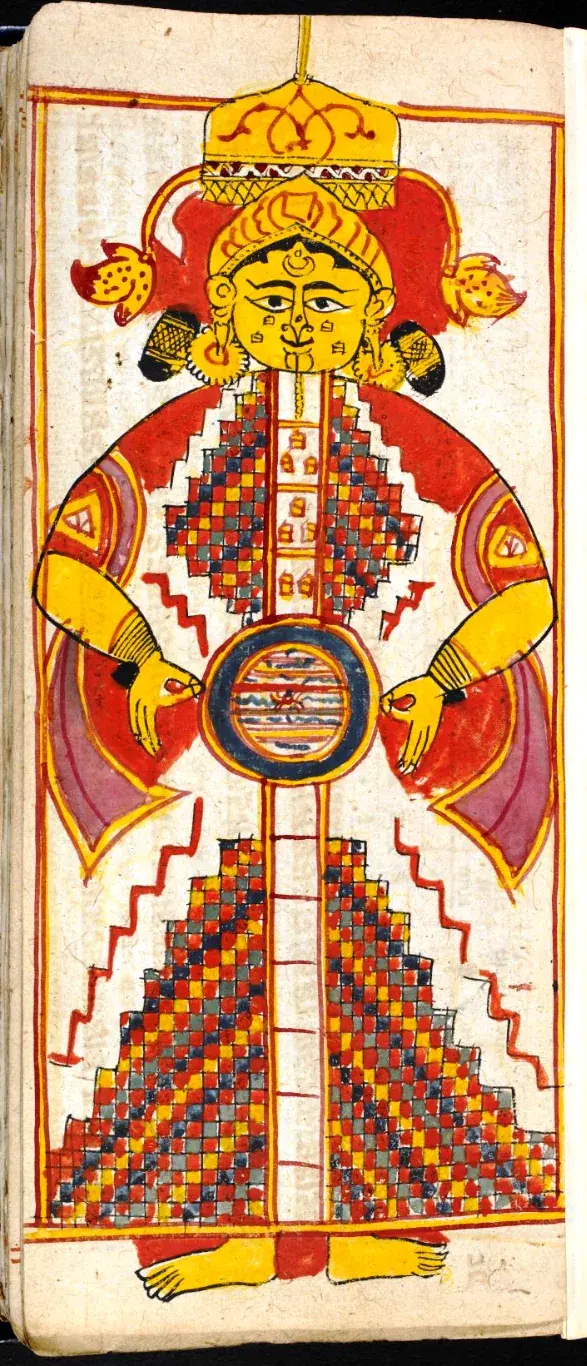
British Library, 14 Rajaloka or Triloka, 17th century, Public domain. Converted to WebP.
What a tattva is
A tattva is a fundamental category of what exists. The nine are not nine beliefs to be assented to; they are the moving parts of a single account of how a soul gets caught and how it gets out.
Their importance is structural. Samyak darshan, the first of the three jewels, is defined in the Tattvarth Sutra as correct conviction regarding the tattvas. Understand these properly and right faith follows; misunderstand them and the whole path is being walked in the wrong direction.
The nine
- Jivaजीव
- The soul. Conscious, without beginning or end, and in its own nature possessed of infinite knowledge, perception, bliss and energy. Every living thing has one, and no soul is worth more than another.
- Ajivaअजीव
- Everything that is not soul: matter, the medium of motion, the medium of rest, space and time. Real, but without consciousness.
- Asravaआस्रव
- Influx. The soul's activity of body, speech and mind draws karmic matter toward it, the way an open window admits dust.
- Bandhaबंध
- Bondage. The karma that has arrived actually binds to the soul. What determines how tightly is not the act but the passion behind it, which is why intention is decisive throughout Jain ethics.
- Punyaपुण्य
- Merit. Karma of a pleasant kind, produced by good conduct. It buys a better birth, but it is still karma and still binds.
- Paapपाप
- Demerit. Karma of an unpleasant kind, produced by harmful conduct.
- Samvaraसंवर
- Stoppage. Closing the window. Vows, carefulness in movement and speech, restraint of the senses and equanimity all prevent new karma from arriving.
- Nirjaraनिर्जरा
- Shedding. Removing the dust already inside. Karma falls away by itself when it ripens, but austerity sheds it deliberately and far faster.
- Mokshaमोक्ष
- Liberation. Every particle of karma gone. The soul, now unobscured, rises to the summit of the universe and remains there in its own nature for ever.
Karma is a substance, not a score
This is where Jain thought differs most sharply from the popular idea of karma, and it is worth pausing on. Karma here is not a cosmic accounting of deserts. It is pudgala, matter, in an extremely fine form, drawn to the soul by activity and held there by passion.
Two consequences follow, and both shape Jain practice. There is no judge, because none is needed; matter behaves as matter does and nobody is issuing verdicts. And karma can be removed by effort in this life, because a physical accretion can be shed. That second point is the entire reason austerity occupies the place it does in Jain religion.
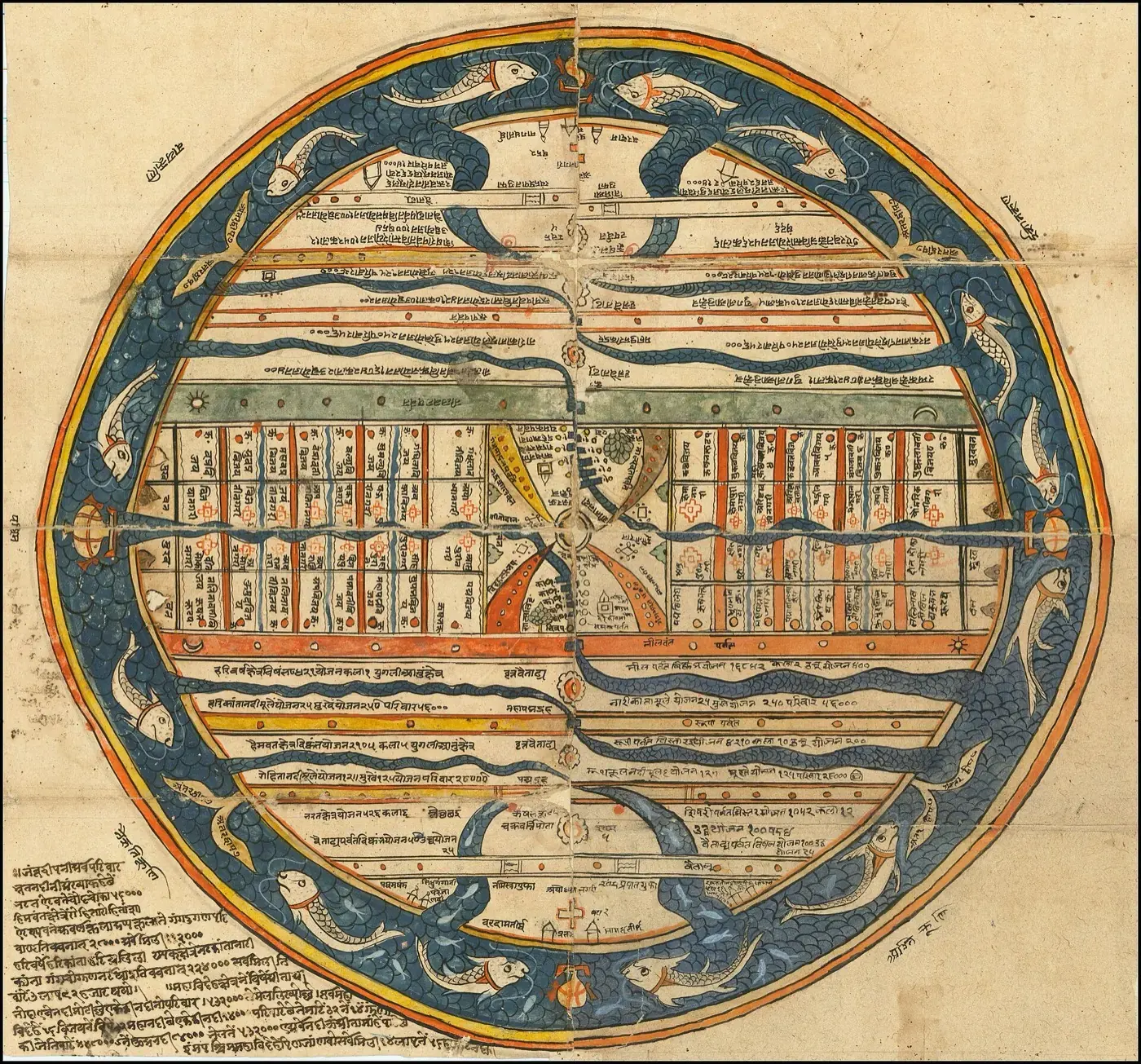
Anonymous, Jain Cosmological Map of the Universe, Jambudvipa, Public domain. Resized and converted to WebP.
Reading the nine as a sequence
The order is not arbitrary. There is a soul and there is non-soul. Karma flows in, and it binds, pleasantly or unpleasantly. Then the flow is stopped and the accumulation is shed. What is left when nothing remains is liberation.
Terms on this page
- Tattvaतत्त्व
- A fundamental category of what exists. Right faith is defined in the Tattvarth Sutra as correct conviction about exactly these.
- Jivaजीव
- The soul. Conscious, eternal, and present in every living thing down to a single-sensed being in a drop of water.
- Karmaकर्म
- In Jain thought, not a moral ledger but literal subtle matter that adheres to the soul and obscures its nature.
- Samvaraसंवर
- Stopping the inflow of new karma. The first of the two operations that liberation actually consists of.
- Nirjaraनिर्जरा
- Shedding the karma already accumulated, principally through austerity. The second of the two operations.
Common questions
If karma is matter, is there no God deciding anything in Jain dharma?
Correct. Jain dharma has no creator and no judge. The universe is uncreated and eternal, and karma operates by its own nature without anyone administering it. Liberated souls are venerated as the proof that the path works, not petitioned as authorities over it.
Is punya, merit, not a good thing to accumulate?
It is better than paap, and it produces a fortunate birth. But the goal is not a better cage. Punya is still karma and still binds the soul, so the final aim is to stop producing either kind, which is what samvara means.