Ahimsa, Anekantavada, Aparigraha
Non-violence in action, non-absolutism in thought, non-attachment in possession. The three pillars, and how they hold each other up.
Principles
4 min read
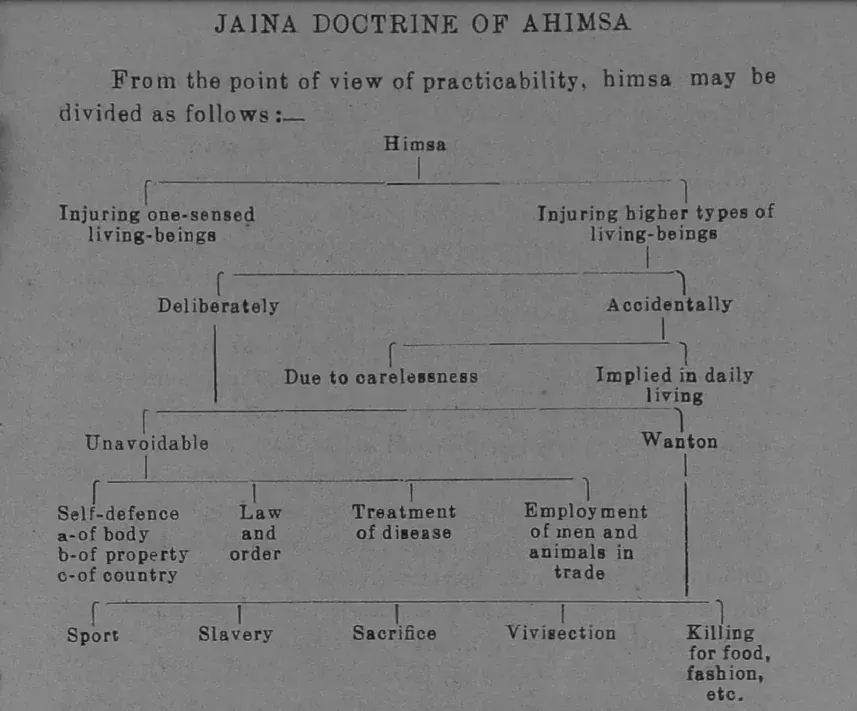
Champat Rai Jain, The Jaina Doctrine of Ahimsa, 1933, Public domain. Converted to WebP.
Ahimsa, and how far it reaches
Ahimsa is the first of the five vows and the principle every other Jain practice is derived from. It is often translated as non-violence, but the Jain version is considerably wider than that phrase suggests in English.
It reaches in two directions at once. Across kinds of living being, it covers not only humans and animals but insects, plants and the one-sensed lives Jain biology recognises in earth, water, fire and air. Across kinds of act, it covers not only doing harm but causing another to do it, and approving of it once done, in thought as much as in word or deed.
The practical consequence is that intention counts. Jain texts hold that harm done carelessly binds karma more heavily than harm that could not have been avoided, because the carelessness was a choice. This is also why complete ahimsa is understood to be impossible for a householder and only approached by an ascetic. The vow is a direction of travel, not a pass or fail.
Anekantavada, non-violence of the mind
Anekantavada holds that reality has many aspects and that no single standpoint takes in all of them. It follows that any statement, including a true one, is partial, and that insisting on one's own view as the complete account is a kind of error.
It has a grammar. Syadvada requires an assertion to be prefixed with syat, meaning in some respect, so that the standpoint is carried in the sentence itself. Nayavada is the companion doctrine that each such standpoint, a naya, is a legitimate partial view which becomes false only when it claims to be the whole.
Jain teachers describe anekantavada as ahimsa applied to the intellect. To insist that one's own position is total is to do a kind of violence to another's understanding, and the habit of qualifying one's claims is the mental equivalent of stepping carefully.
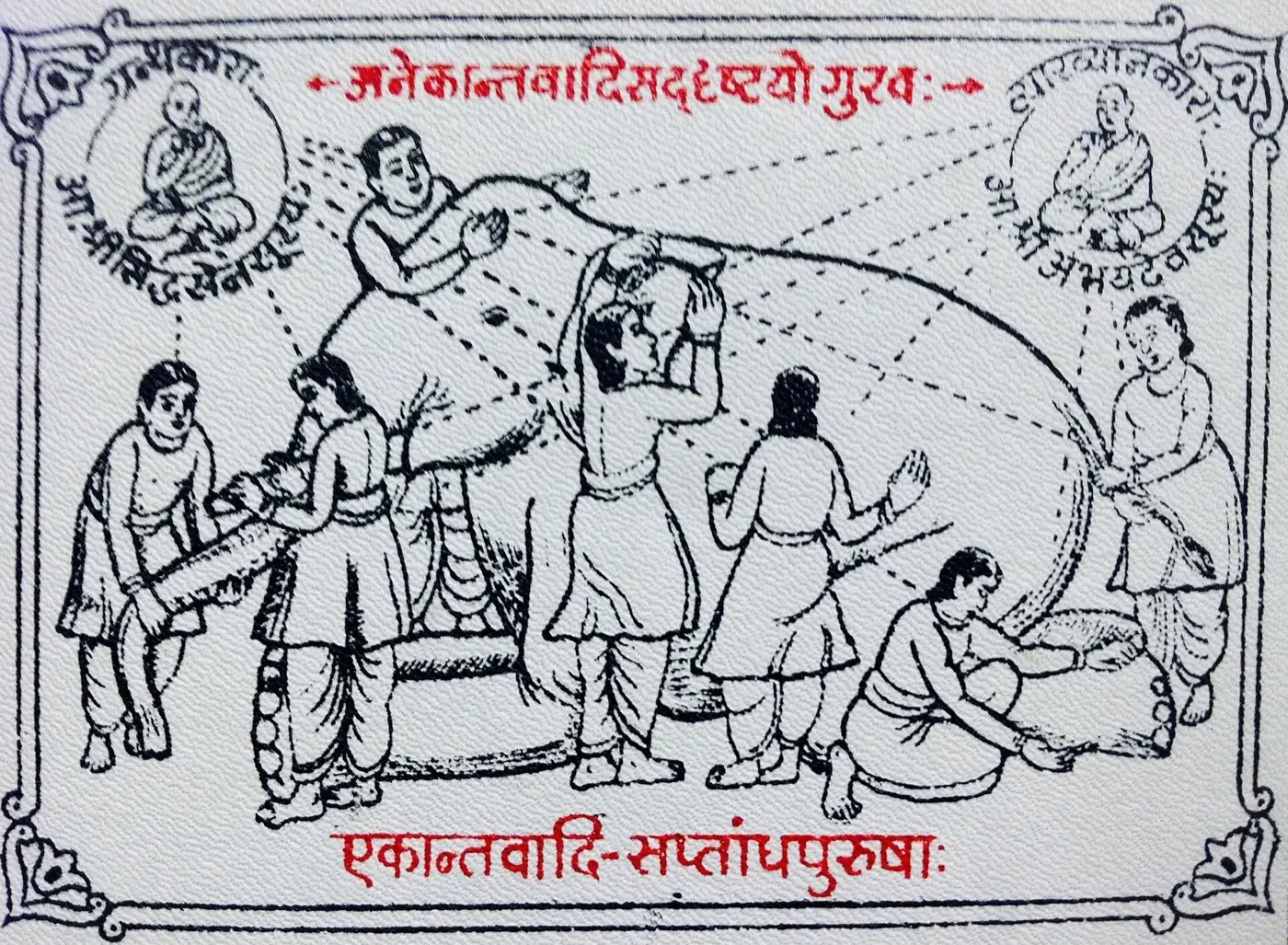
romana klee from usa, Medieval Jain temple Anekantavada doctrine artwork, CC BY-SA 2.0. Resized and converted to WebP.
Aparigraha, and what it is actually about
Aparigraha is usually rendered as non-possession, which invites the assumption that the problem is property. It is not. The Jain texts locate the difficulty in murchha, attachment, the state of being gripped by what one owns or wants to own.
A householder practises it by setting limits, a vow known as parigraha parimana: a ceiling on land, on wealth, on goods, fixed in advance and not revised upward whenever it is reached. What lies above the ceiling is given away. An ascetic takes it to its end and keeps nothing at all, which in the Digambar tradition includes clothing.
How the three hold together
They are not three separate rules. Attachment is what makes a person willing to harm, so aparigraha removes the motive for himsa. Certainty that one's own view is complete is what makes a person willing to override another, so anekantavada removes the motive for a different kind of harm. Ahimsa is the aim; the other two are what make it reachable.
परस्परोपग्रहो जीवानाम्
Parasparopagraho jīvānām
Souls render service to one another.
This line sits beneath the Jain emblem as its motto. It is the reason the three principles are stated as obligations rather than preferences: if all life is held together by mutual support, then harm, dogmatism and hoarding are not merely unkind, they are a misreading of how things actually stand.
Terms on this page
- Ahimsaअहिंसा
- Non-violence, extending to thought and speech as well as action, and to every living being rather than only to humans.
- Anekantavadaअनेकांतवाद
- The doctrine of many-sidedness. Reality has more aspects than any single viewpoint can capture, so no one view is ever the whole account.
- Syadvadaस्याद्वाद
- The way anekantavada is spoken. Every assertion is prefixed with syat, in some respect, to mark that it is true from a standpoint and not absolutely.
- Aparigrahaअपरिग्रह
- Non-possession. Limiting what one owns and, more importantly, what one wants; attachment rather than property is the actual target.
- Parasparopagraho jivanamपरस्परोपग्रहो जीवानाम्
- All life is bound together by mutual support. A line from the Tattvarth Sutra, adopted as the motto beneath the Jain emblem.
Common questions
Is anekantavada the same as saying every opinion is equally valid?
No. A naya is a valid partial view of something real; a claim that is simply false does not become a naya by being sincerely held. What anekantavada rules out is the assumption that one's own correct view is the complete one.
If even plants have life, how is any eating non-violent?
It is not, and Jain teaching does not claim otherwise. The householder's obligation is to minimise harm, not to reach zero, which is why the tradition prefers one-sensed life to many-sensed, avoids foods that destroy the whole plant, and treats eating as an act requiring restraint rather than an act beyond question.