The Navkar Mantra
The first mantra a Jain learns. It bows to qualities, never to a person.
Foundations
4 min read
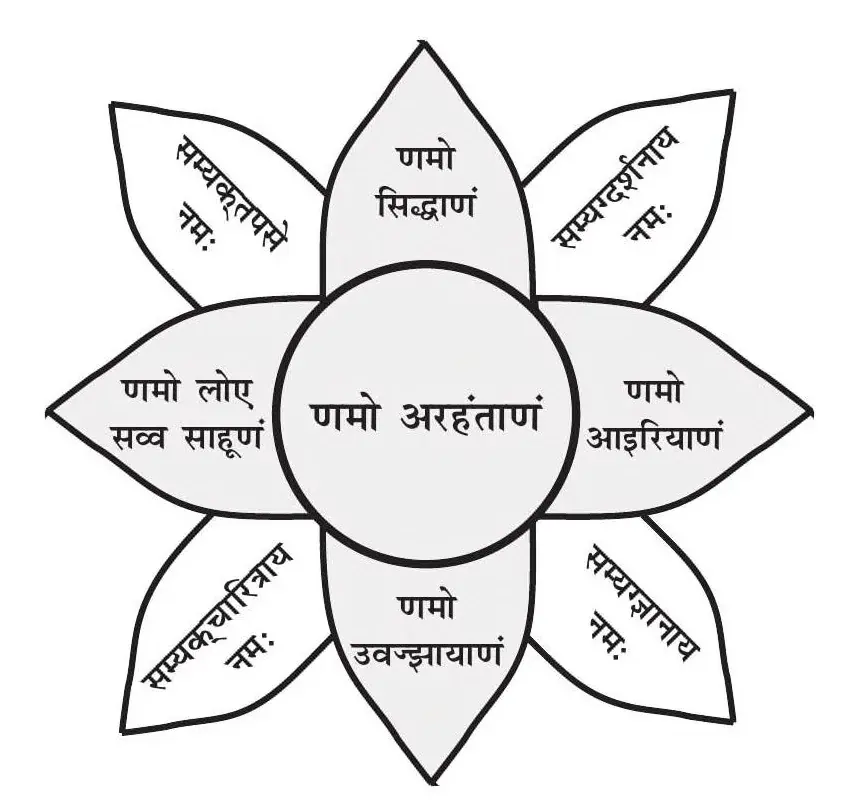
Vijay K. Jain, Pañca-Parameṣṭhi, CC0 1.0. Converted to WebP.
The mantra
Nine lines in Prakrit, the spoken language of Mahavir's time. Five are salutations. Four say what the salutation does.
णमो अरिहंताणं
Ṇamo Arihantāṇaṁ
I bow to the Arihants, those who have conquered the inner enemies.
णमो सिद्धाणं
Ṇamo Siddhāṇaṁ
I bow to the Siddhas, the liberated souls.
णमो आयरियाणं
Ṇamo Āyariyāṇaṁ
I bow to the Acharyas, the heads of the ascetic order.
णमो उवज्झायाणं
Ṇamo Uvajjhāyāṇaṁ
I bow to the Upadhyayas, who teach the scriptures.
णमो लोए सव्वसाहूणं
Ṇamo Loe Savva-sāhūṇaṁ
I bow to all Sadhus everywhere in the world.
एसो पंच णमोक्कारो, सव्वपावप्पणासणो
Eso pañca ṇamokkāro, savva-pāvappaṇāsaṇo
This fivefold salutation destroys all sin.
मंगलाणं च सव्वेसिं, पढमं हवइ मंगलं
Maṅgalāṇaṁ ca savvesiṁ, paḍhamaṁ havai maṅgalaṁ
Of all that is auspicious, it is the first and foremost.
The five salutations run to thirty-five syllables. With the four closing lines, the chulika, the whole passage is sixty-eight. Children are taught the five first and the chulika later, which is why you will hear both lengths recited in the mandir.
Who is being saluted
Five categories, together called the Panch Parameshthi, the five supreme beings. Two of them have completed the journey. Three are still walking it, and are saluted for how far they have come.
- Arihantअरिहंत
- One who has destroyed the four ghati karmas, the karmas that obscure knowledge, perception, energy and bliss, and so has attained omniscience while still living in a body. A Tirthankar is an Arihant who also establishes the fourfold order.
- Siddhaसिद्ध
- A soul that has shed all karma and left the body behind. Siddhas have no form, no name and no further birth. They reside at the summit of the universe and are the only beings a Jain considers fully free.
- Acharyaआचार्य
- The head of an ascetic order. An Acharya has taken the great vows in full and carries the responsibility of admitting new ascetics and correcting lapses in conduct.
- Upadhyayaउपाध्याय
- The teacher of the order. Where the Acharya governs conduct, the Upadhyaya transmits the scriptures to ascetics who are still learning them.
- Sadhuसाधु
- Every ascetic who has taken the five great vows, anywhere in the world, of any tradition. The line says loe savva, all in the world, and it means it.
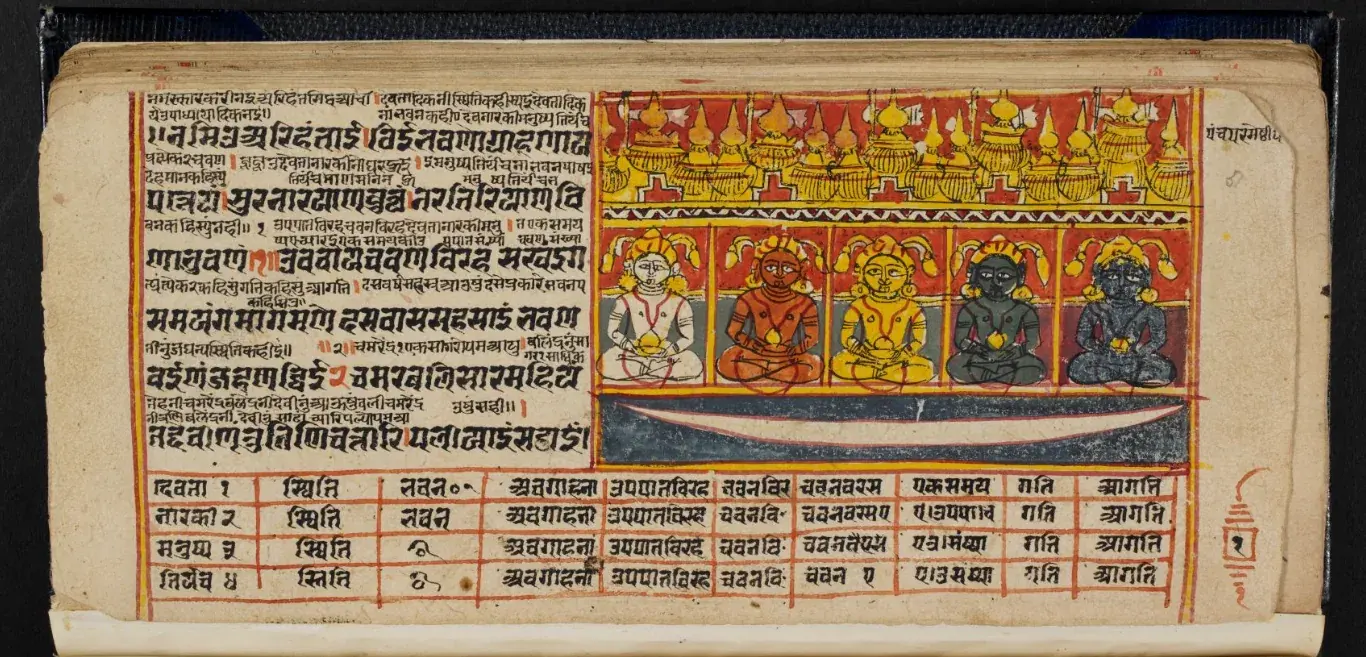
British Library, Folio from the Saṁgrahaṇīratna by Śrīcandra, Or 2116C, Public domain. Converted to WebP.
Why it names no one
The mantra mentions no god, no Tirthankar by name, not even Mahavir. This is deliberate and it is the single most important thing about it. What is being saluted is a state, not a personality. Anyone who reaches that state becomes worthy of the same bow, whenever and wherever they lived.
It follows that the mantra asks for nothing. There is no request in it, no petition, no bargain. A Siddha has no involvement in the world and cannot grant a wish; the benefit of the salutation is what it does to the person reciting it. This is why Jains describe the mantra as removing sin rather than as pleasing anyone.
How it is used
The Navkar Mantra opens every Jain ritual and most Jain days. It is recited on waking, before eating, before travelling, at the start of a puja, at the start of a business ledger, and at the bedside of the dying. There is no wrong time and no qualification required to say it.
- Recited once, or in counts of nine, twenty-seven or one hundred and eight on a mala.
- Said aloud in the mandir and silently in samayika, the daily period of equanimity.
- Written at the head of a letter, an account book or an invitation, as a mark of auspicious beginning.
Terms on this page
- Navkar Mantraणमोकार मंत्र
- The fivefold salutation, and the most widely recited passage in Jain practice. Also written Namokar or Namaskar Mantra.
- Chulikaचूलिका
- The four closing lines that follow the five salutations, describing what the salutation accomplishes.
- Namoणमो
- Prakrit for 'I bow'. Each of the five lines begins with it, and each bows to a class of beings rather than to an individual.
Common questions
Is the Navkar Mantra a prayer to God?
No. Jain dharma has no creator god, and the mantra asks for nothing. It is a salutation to five categories of spiritually advanced beings, and its effect is understood to work on the person reciting it rather than on any listener.
Can a non-Jain recite the Navkar Mantra?
Yes. Because the mantra names no sect, no deity and no person, nothing in it is closed to anyone. Reciting it requires no initiation and no permission.